

SWIM COACHES
STROKE ASSESSMENT - JULY 2025
In July 2025, I travelled to Ripley, Surrey for a stroke assessment. I figured there’s not much point increasing distance and hours, if I’m not being as efficient as possible with my stoke.
Steve Wadey was recommended to me at the DCT Conference in March, as being a really good coach for technique. Well that was an understatement! It turns out he’s ex-Sport England and widely regarded as one of the finest technical swim coaches in the UK, having coached swimmers to national and international success. He mentors other coaches, some of whom have been selected to coach for Great Britain. He has 30 years experience and most importantly for me, he’s particularly renowned for his breaststroke expertise.

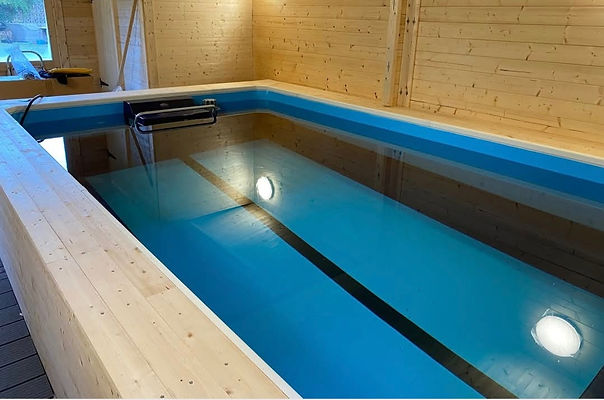
So I was excited, privileged and slightly nervous of my session with him. After a brief chat, he watched me swim, increasing the speed of the endless pool flow until I couldn’t keep up, the idea being to see how my stroke changed with speed. His first comments were ”before you arrived, looking on paper at the facts, your goal and your breaststroke preference, I thought it was a very small window of possibility. Now I’ve spoken to you, heard what you’re willing to do and seen you swim, that window has suddenly got much bigger”. Boy did that increase my confidence!
He gave me advice on small but important adjustments to head height, arm angles, hand shapes & feet positions. He offered insight on some technique differences between competitive speed swimming and endurance swimming (who knew?), resulting in me knowing which online video tips to completely ignore in future!
It's all about making the stroke as efficient as possible for long distance, but also reasonably comfortable for all the hours required. I’ve been able to practice some of the adjustments during my swims since then and gosh, I don’t know about comfortable, it doesn’t half make my shoulders hurt!
SWIM COACH - JULY 2025

Finally, I have a coach! While Steve is a technical coach, he’s not the person to see me through to 2027 with training plans and feeding advice.
With radio silence from the coach I chatted with in June, and desperate to still secure someone, I contacted the delighted DCT asking for recommendations. I was delighted to receive a reply from the lovely Emma France (what a perfect name for channel swims), Director & Head Coach of DCT, offering me a conversation with a view to possibly taking me on herself - wow! Some of her clients had done their swims in June/early July, thus freeing her up a little.
During a Zoom call a few days later, she dissected what happened during Windermere last year, gave me some tips for this year (about earplugs, feeding and feeling grumpy! See Learnings), as well as tips on cold acclimatisation, other possible interim swims before 2027 and how her training works, i.e. what I get for my money. She said Steve had told her I was mentally strong and on that basis, she agreed to take me on, as mental toughness is one of the main things she looks for in a new client which is why she doesn’t take everyone who asks. Woo-hoo! I’m so excited to finally have an English Channel swim coach!
I’ll start with her sometime after Windermere as she's already given me some tips for that. She’ll provide weekly/monthly training plans, particularly for speed & technique practice in the pool over the winter months. My swims will upload to an online platform she can monitor for distance, time, speed & effort, etc. We’ll have a Zoom call once a month for catch ups/questions and she offers unlimited WhatsApp support in between.
Emma has done 3 solo & 20 relay channel crossings, so I’d better pay attention!
Finding these coaches has been two big ‘to do’ boxes ticked off for me. So I really feel I’m firmly on the yellow brick road and at least pointing the right way, with the right support behind me.
STROKE ASSESSMENT
NOVEMBER 2025
Breaststroke
On 8th November I visited technique coach Steve Wadey again. I‘ve been working on the breaststroke tips he gave me in July (most of which vanished during Windermere!). So I needed a follow up on that, plus some tips on front crawl.
While I anticipate my big swim will be mostly (if not all) breaststroke, I want to improve my crawl, should I need to switch stroke for limb/joint relief or speed. Hours of repetitive movement can play havoc with arms and legs, so some crawl might be good to stretch my shoulders and give my knees a break. As for speed, boat pilots often ask swimmers to speed up for 30 minutes/an hour/two... to break through the tide or get across the shipping lane swiftly. So my front crawl needs tightening up.
Breaststroke is a 3-stage stroke: Kick/Glide/Pull. Generally, people don’t glide nearly long enough, but it’s a really important element of the stroke. The glide is powered by a strong kick, making full use of its force while conserving energy before the next arm pull. If the glide is too short, you waste energy on an unnecessary arm stroke; too long and you start to lose swim power and speed.
Steve’s breaststroke tweaks for me in July:
-
Keep head horizontal - look straight down (not forward 45°) to reduce drag.
-
Head/shoulder/hips should be aligned, flat and streamlined during the glide.
-
Keep head higher so it’s half out the water. My head was totally submerged, making it further to travel when coming up to breathe.
-
Don’t cut the kick short. Complete it by ensuring feet meet at the back. (I’ve been working on feeling my ankles touch).
-
When shooting arms forward, ensure arms/elbows are completely straight, close to my head (almost touching ears) during the glide.
I’m told my kick is strong and my glide is good.
Steve’s further breaststroke tweaks for me this visit:
-
Open arms to a ‘10 to 2’ width only, before circling inwards. Anything wider doesn’t help the stroke and is wasted energy.
-
Swivel hands 180° from facing outwards when pushing water away, to inwards when circling back in. Push out slowly; circle in and shoot forward fast.
-
Keep chin tucked in as if holding a tennis ball, so when breathing, come up by the shoulders, not the neck; maintain alignment.
Front Crawl
Front Crawl is a 5-stage stroke: Entry/Catch/Pull/Finish/Recovery:
-
Entry: Arm straight in front (don’t cross the invisible middle line), entering the water with a straight hand (middle finger first) which helps a good catch.
-
Catch: As the hand enters the water, don’t circle arms like windmill sails(!); instead, keep a high/bent elbow position to ‘catch’ the water with your forearm and create early propulsion (imagine rolling your arm round a beach ball).
-
Pull: Pull the arm straight back to move the water directly behind you.
-
Finish: Keep pulling until your hand is level with your thigh. People often lift arms out when they get level with their waist, underutilising their stroke.
-
Recovery: Getting the arm out the water and back to the front, aided by the momentum of a good ‘finish’, ready for a straight hand entry again.
Steve’s front crawl tweaks for me:
-
Legs closer together, feet pointed slightly inwards, so big toes almost touch.
-
As I’m hypermobile, what feels like straight arms to me, isn’t. So during ‘entry’ I need to consciously turn elbows outward (not bend them) to make my arms actually straight, which in turn, helps body rotation.
-
Keep elbows high during the catch - yes yes yes, I know...
-
Finish the stroke. Imagine marker pens in place of thumbs and draw a line on your thigh before lifting arms up/out. I’d already worked on this a little, but obviously not enough!
Hmm, lots to practice...